



As we enter the final quarter of 2026, there are encouraging signs of stabilisation in the recruitment market. Hiring confidence in the UK is beginning to improve, but businesses remain selective about senior appointments.
The more interesting story is how the expectations of leadership are changing. From greater pay transparency and the evolving role of the CMO to the growing importance of AI transformation, organisations are rethinking how they attract, assess and reward senior talent.
Here are the developments that have caught my attention this autumn, and what they mean for business leaders.
What you need to know
- The UK market is showing encouraging signs of recovery, while the US remains resilient despite a more cautious outlook. UK permanent placements returned to modest growth in September, while the latest IPA Bellwether Report points to UK marketing budgets revised up by the most in over two years and a welcome improvement in hiring intentions.
- In the US, we’re seeing a more measured but resilient market. The Conference Board’s latest survey shows large-company CEO confidence falling to 46 from 52, with 33% of CEOs expecting to expand headcount and 31% expecting to cut. Taken together, this is stabilisation rather than acceleration, and employers remain selective about senior appointments.
- Pay transparency is moving up the executive hiring agenda. New EU requirements and established legislation across parts of the US are likely to encourage greater global consistency, which makes robust remuneration benchmarking and market intelligence more important.
- The CMO role continues to evolve. As businesses consolidate responsibility for marketing, customer and growth, the bigger question is whether CEOs and shareholders recognise the contribution strategic marketing leadership makes to enterprise value.
- AI is reshaping both leadership expectations and recruitment. Our analysis of hundreds of senior leadership profiles shows a significant gap between AI adoption and proven transformation experience. Rising application volumes make specialist assessment and human judgement more important.
A market finding its feet
The latest KPMG/REC UK Report on Jobs suggests the permanent recruitment market is beginning to stabilise. September’s permanent placements index reached 50.9, moving back into modest growth territory. A reading of 50 means no change.
London recorded 50.4, while its vacancies index stood at 51.5. These are encouraging signals, although hardly evidence of a sustained recovery.
There is further encouragement from the latest IPA Bellwether Report, which shows UK marketing budgets revised upwards by the most in over two years, with investment increasing across all major categories. Perhaps more significantly for the leadership market, hiring intentions among surveyed businesses have returned to positive territory for the first time in seven quarters.
In the US, we’re seeing a more measured but resilient market. The Conference Board’s survey of large-company CEOs, carried out with The Business Council, shows confidence falling to 46 in Q4 2026, down from 52 last quarter. A third of those CEOs (33%) expect to expand their workforce, although 31% still expect to make cuts.
Taken alongside the improving UK recruitment figures, this points to a market that is stabilising rather than accelerating. UK businesses are starting to look beyond cost control, while US CEOs have become more cautious about the months ahead. Increased marketing budgets won’t automatically translate into senior hiring, and the transatlantic picture is a reminder that confidence is fragile.
What we are seeing at tml Partners
Our experience reflects this cautious picture. Businesses are still making senior appointments, but decisions are slow and the scrutiny around each hire is greater. Clients want clarity on:
- the commercial impact a leader will deliver
- the capabilities they bring
- how they will contribute to future growth
There is undoubtedly opportunity in the market. But confidence remains selective rather than widespread.
Pay transparency: a significant shift in executive recruitment
One of the most important developments for employers to watch is the growing momentum behind pay transparency.
What is changing
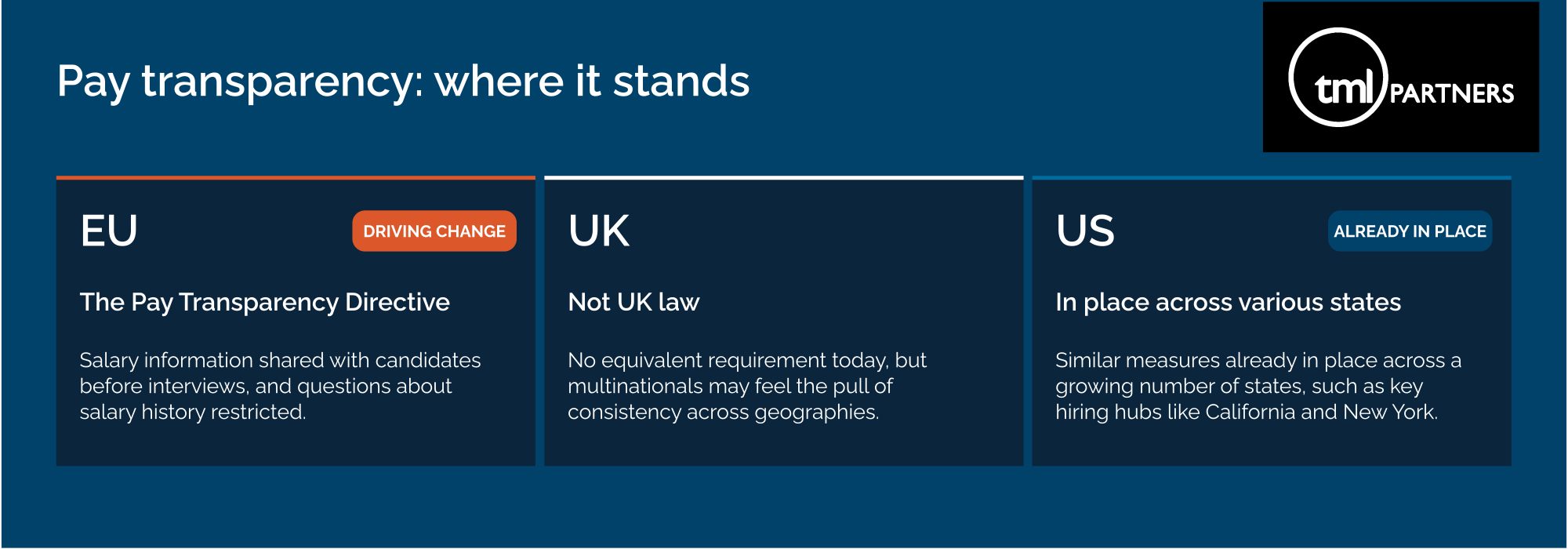
The EU Pay Transparency Directive is changing how organisations communicate remuneration. That includes giving candidates salary information before interviews and restricting questions about their salary history.
These requirements are not UK law. But similar measures are already in place across a growing number of US states, including California and New York. For multinational businesses, we expect this to encourage greater consistency in recruitment and reward practices across international markets over the coming years.
There are obvious benefits. Greater transparency can help address unjustified pay disparities, improve candidate confidence and support more informed conversations about remuneration.
Why it is harder at executive level
Senior leadership packages are rarely straightforward. Base salary is only part of the picture. Annual bonuses, long-term incentives, equity and other benefits often represent a significant proportion of total reward.
Packages also vary considerably by sector, geography, ownership structure and the scope of the role.
Why benchmarking matters
This is where robust executive remuneration benchmarking becomes increasingly valuable. Employers need to understand not just what comparable leaders are earning, but how packages are structured, how expectations are changing and whether their own reward propositions remain competitive.
At tml Partners, our specialist networks, market knowledge and talent analytics capabilities help clients build that picture through independent remuneration benchmarking and wider leadership market intelligence.
The organisations best prepared for greater transparency will be those that genuinely understand their market and can explain the rationale behind their reward decisions.
The changing face of marketing leadership: does the title really matter?
The future of the CMO continues to generate debate, and a recent article by Mark Ritson in The Drum particularly caught my attention.
The case that the role is shrinking
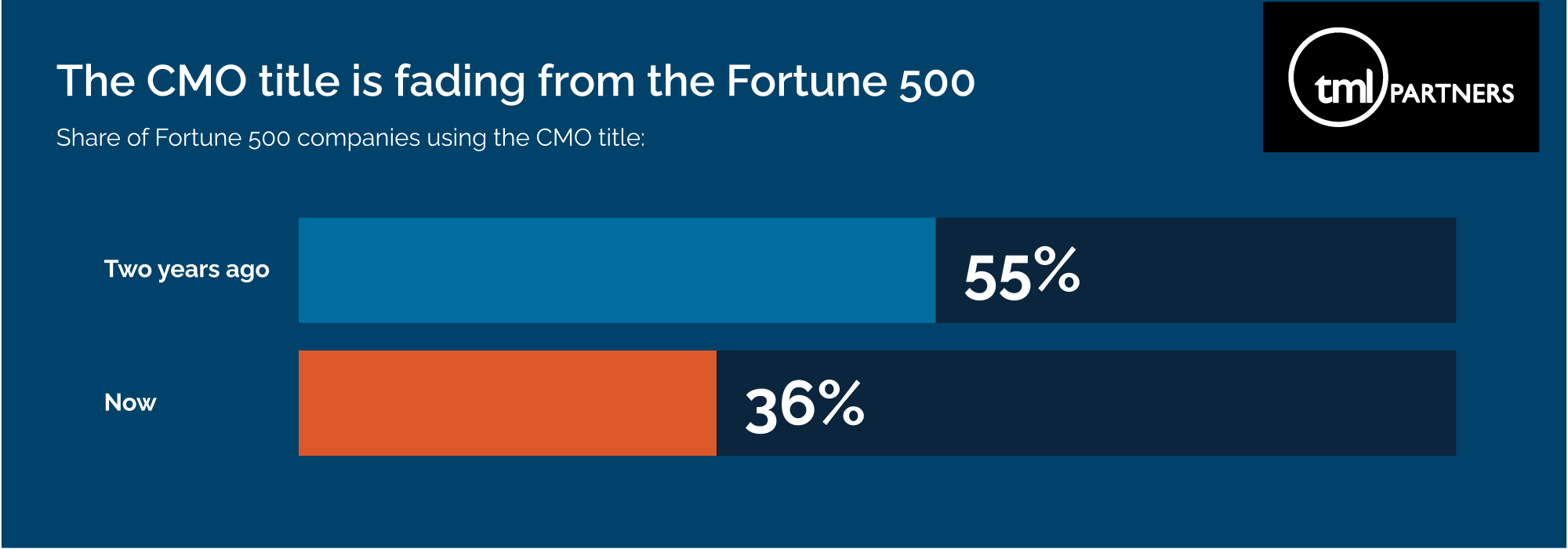
Ritson argues that the CMO role has been shrinking, with businesses adding responsibility for customer experience, growth and commercial performance. He points to Forrester research showing that just 36% of Fortune 500 companies now use the CMO title, down from 55% two years earlier.
We are certainly seeing this evolution in our own executive search work. It is particularly noticeable in private equity-backed businesses, where Chief Revenue Officers and Chief Growth Officers increasingly take responsibility for the broader commercial agenda, often with a Marketing Director reporting into them.
But is the real issue the title?
I think the more important question is whether CEOs and shareholders fully understand the contribution great marketing leadership makes to enterprise value.
McKinsey research provides compelling evidence:
- Companies with a single customer or growth leader on the executive committee grew up to 2.3 times faster than those where responsibility was fragmented.
- CEOs who put marketing at the heart of their growth strategy were twice as likely to achieve annual growth above 5%.
Research into FTSE 100 boards adds nuance. None has a dedicated CMO or marketing director on its main board, yet 70% have directors with marketing, customer or brand expertise.
Marketing’s relevance to business strategy clearly has not disappeared. But its organisational positioning is changing.
Who is getting the jobs?
Recent Pearlfinders research adds another dimension. It suggests that 62% of senior marketing appointments over the past year went to external candidates, rising to 73% in September. Organisations are continuing to seek fresh capabilities and perspectives.
My conclusion
I have had hundreds of conversations on this subject across businesses of different sizes, sectors and ownership structures, and I keep coming back to the same conclusion.
CEOs and shareholders either understand the strategic value of marketing or they don’t. If they don’t, changing the title rarely fixes the problem.
For marketing leaders, the opportunity is to demonstrate their impact on customer value, commercial performance and sustainable growth. For CEOs and shareholders, it is about creating the right mandate, accountability and influence for marketing leadership to succeed.
AI: the difference between adoption and transformation
AI is now firmly embedded in conversations about leadership capability. But there is a significant difference between using AI and having the experience to lead meaningful transformation.
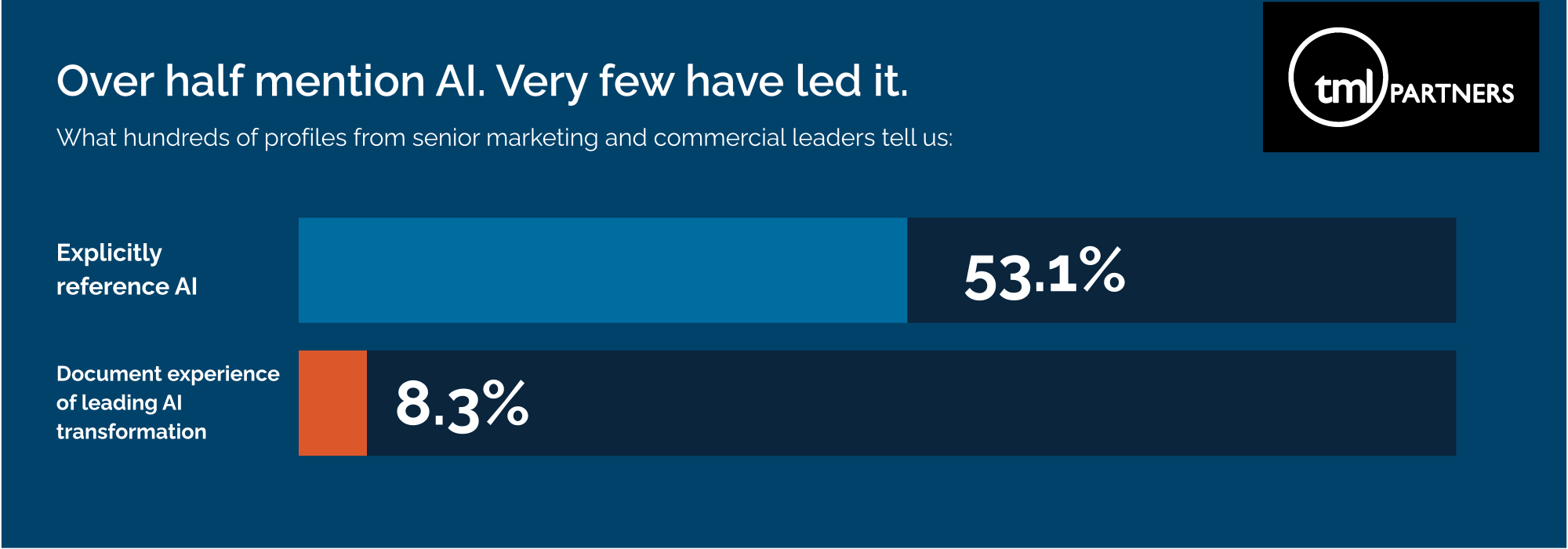
Through our talent analytics work, we have reviewed hundreds of senior marketing and communications leadership profiles over the past year. One finding stands out.
53.1% explicitly reference AI.
8.3% demonstrate documented experience of leading strategic AI transformation.
That is a considerable gap.
Of course, a CV or professional profile does not capture everything a leader has achieved. But it does highlight the importance of looking beyond familiarity with new tools when assessing leadership capability.
From experimentation to measurable impact
The real challenge for businesses is moving from experimentation to measurable impact. That means:
- redesigning operating models
- improving productivity
- identifying new commercial opportunities
- bringing people through organisational change
The leaders who can combine commercial judgement, technological understanding and the ability to deliver transformation will become increasingly valuable.
For employers, assessing these capabilities requires more than reviewing job titles or searching for AI-related keywords. It demands deeper research, evidence of outcomes and a clear understanding of what successful transformation looks like.
AI and recruitment: more applications, more complexity
AI is also changing the recruitment process itself. New technologies make it easier to research opportunities, prepare applications and automate parts of hiring. There is genuine potential to improve efficiency and free up more time for meaningful human interaction.
The unintended consequences
- More applications, harder decisions. We are seeing a growing volume of applications, many of them AI-assisted. That makes it harder for employers to identify genuinely relevant candidates and give thoughtful feedback.
- Questions about fairness. The increasing use of automated screening raises legitimate questions about transparency and whether good candidates could be overlooked.
These are challenges the recruitment industry needs to take seriously. Technology should help improve hiring decisions, not simply accelerate the processing of applications.
Candidates have a role to play too. A targeted approach, focused on opportunities where their experience and achievements are genuinely relevant, is likely to be more effective than applying at scale.
Why human judgement matters more
For executive search in particular, we believe the value of specialist research, trusted relationships and informed human judgement will only increase.
AI can help us work more intelligently. But assessing leadership potential, cultural fit, motivation and the ability to deliver commercial outcomes remains a fundamentally human exercise.
Looking ahead to 2027
There are reasons for cautious optimism as we approach the end of the year, although I don’t expect a straightforward return to the hiring conditions of previous cycles.
What is clear is that expectations of senior leaders continue to rise. Businesses need leaders who can:
- demonstrate commercial impact
- navigate technological change
- operate effectively across increasingly complex organisational structures
For employers, making the right appointment will depend on combining strong market intelligence with a clear understanding of the capabilities that create value. At tml Partners, we continue to invest in specialist research, talent analytics and leadership intelligence to help clients navigate these decisions with greater confidence.
The organisations that make the strongest leadership decisions in 2027 will be those that look beyond conventional job descriptions and focus on the outcomes they need to achieve.
Want to talk through your leadership priorities? Get in touch with the tml Partners team.
The CMO Report – Our third edition is coming
Our marketing team is busy finalising the details of the third edition of The CMO Report, and we’re looking forward to sharing it with you.
For the first time, we’re also combining what senior marketing leaders tell us through our research and conversations with a deeper analysis of what our own talent-market data reveals.
We’re looking forward to sharing these insights and hearing your perspectives on what they mean for the future of marketing leadership.
More on The CMO Report coming soon.
Also worth reading

The Intelligence Advantage: How Marketing and Commercial Leaders Are Aligning Strategy with Digital Execution
tml Partners was delighted to partner with Living Group to publish The Intelligence Advantage, an event report examining how marketing, growth and commercial leaders at the world’s leading financial and professional services firms are aligning strategic identity with digital execution, in a landscape being reshaped fast by AI.
Sector Spotlight: Legal Marketing and Business Development
We are pleased to share our latest Legal Marketing, BD and Corporate Affairs Industry Update, drawn from live search activity, client conversations and market data across our Professional Services team
About tml Partners
tml Partners is a specialist executive search firm connecting organisations with outstanding marketing, commercial, product and corporate affairs leadership talent.
We work with ambitious businesses around the world, combining deep sector expertise, trusted relationships and rigorous research to help our clients make transformative leadership appointments.