



For years, professional services firms treated digital transformation as a future ambition. Law firms, accountancy practices, and management consultancies experimented with CRM platforms, marketing automation, and AI-driven analytics. That experimental phase is now coming to an end.
What’s emerging instead is a more fundamental shift: MarTech and data operations are becoming embedded, business-critical capabilities that directly shape growth, client strategy, and talent structures across the professional services landscape.
The rise of operational MarTech
Across leading firms, the conversation has moved from “what tools should we test?” to “how do we operationalise our tech stack at scale?”
Platforms such as Salesforce now sit at the centre of increasingly sophisticated ecosystems linking marketing, business development, client intelligence, and delivery data. Several international law firms are investing heavily in deeper Salesforce capability, expanding MarTech leadership roles, and treating marketing operations as a specialist discipline in its own right.
As a result, firms are no longer hiring simply to manage systems. They are hiring operational leaders responsible for visibility, integration, and commercial performance. Roles such as Marketing Operations Leads, CRM Directors, and Data & Intelligence Managers are becoming permanent fixtures rather than experimental hires.
One of the biggest differentiators in successful AI adoption is the quality and trustworthiness of the underlying data infrastructure. Firms that have invested in structured client data, integrated CRM platforms, consistent governance and clear ownership models are in a far stronger position to operationalise AI effectively.
Craig Ashton-Chalmers, Global Product Lead – Client Systems, Linklaters
Hiring for visibility, not just technology
A recurring theme across the market is the need for better visibility across marketing, BD, and leadership functions. Firms want data that is structured, accessible, and actionable in real time.
This is driving demand for roles such as Senior Marketing Operations Leads, Salesforce Marketing Technology Managers, and Marketing Data & Analytics Leads. These are not incremental hires; they are strategic responses to a more data-led operating environment.
One international law firm, for example, has recently invested in a selection of senior strategy and intelligence capability roles as part of a broader move toward in-house data centres of excellence influencing client growth, pricing, lateral hiring, and service delivery.
This convergence of marketing, intelligence, and operational decision-making is redefining what “client insight” means in professional services.
From SEO to GEO
Another emerging trend is the evolution from traditional SEO toward GEO – generative and AI-influenced discovery models.
Visibility is no longer just about rankings. Firms are beginning to think more carefully about how they are surfaced, interpreted, and recommended within AI-driven environments. For professional services businesses, this changes how thought leadership is created and distributed. Content is becoming more than a marketing output; it is now a data asset feeding discoverability and commercial intelligence.
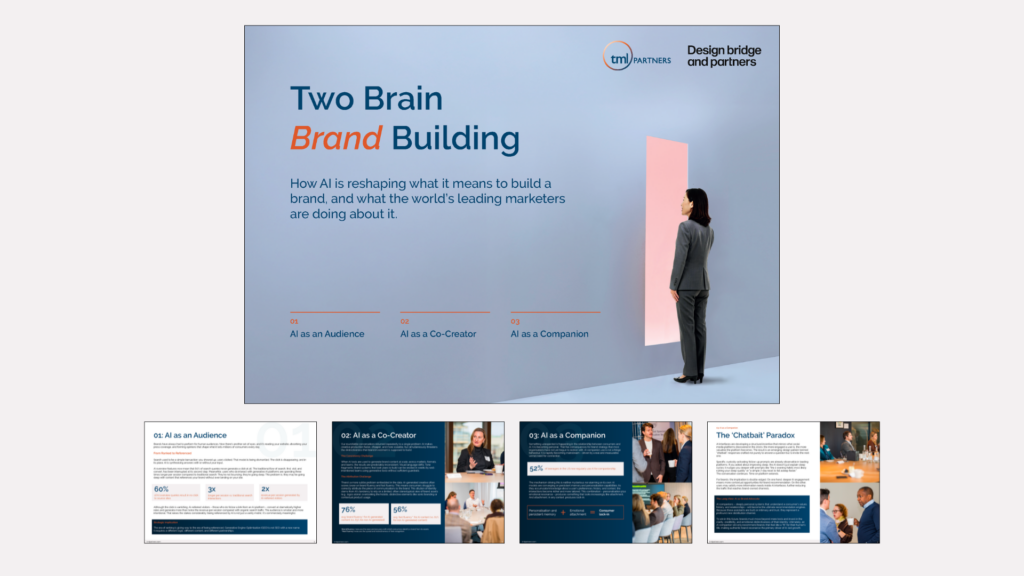
Following a series of recent roundtable discussions, we have recently created the Two Brain Brand Building Report in partnership with Design Bridge and Partners. This report looks at how AI is reshaping what it means to build a successful brand, and dissects AI across three critical themes:
- AI as an Audience
- AI as a Co-Creator
- AI as a Companion
Data literacy becomes a core capability
Perhaps the biggest change is human rather than technological.
Across law, accountancy, and consulting, data literacy is becoming a baseline expectation for marketing and BD professionals. Candidates are now expected to understand performance metrics, ROI frameworks, CRM systems, and how insight informs client strategy.
Hiring managers are no longer assessing professionals solely on sector experience or relationship management capability. There is growing emphasis on familiarity with CRM and marketing automation tools, the ability to interpret pipeline and performance data, and the confidence to work alongside technology and analytics teams.
This is reshaping traditional go-to-market roles. Business development and marketing professionals are now expected to operate in data-rich environments where decisions are increasingly evidence-led rather than intuition-led.
Structural change: the squeeze on traditional junior roles
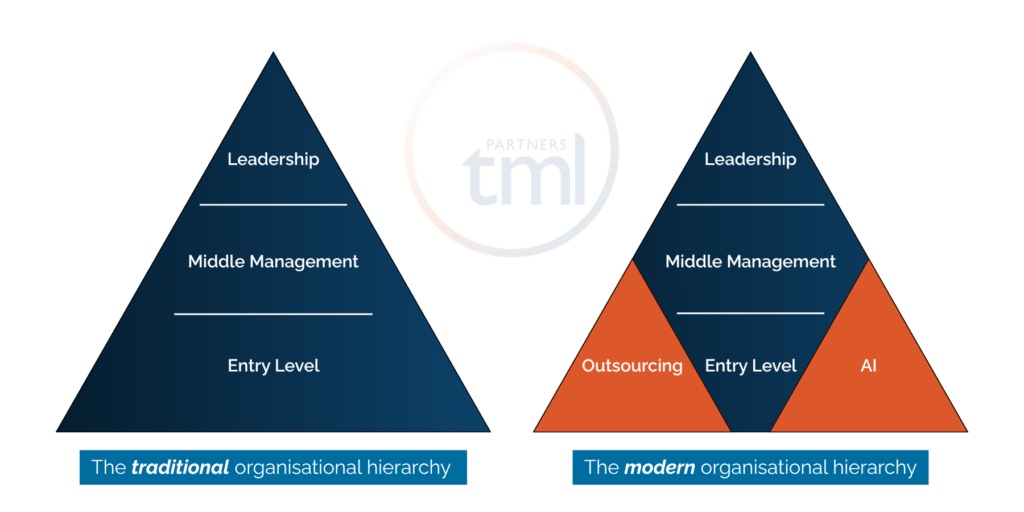
One of the less discussed but more visible impacts of this shift is structural compression at the junior level.
As firms invest in automation, AI, and integrated MarTech platforms, many task-based responsibilities traditionally handled by junior marketers or analysts are being absorbed into systems or consolidated into more senior, technically capable roles.
This reflects a broader change in how work is structured. Routine execution is becoming automated, while human capability is being concentrated around strategy, interpretation, system ownership, and cross-functional coordination.
The rise of data-driven client centricity
Client relationships within professional services are becoming increasingly data-led. Even historical accounts are now underpinned by data to better identify growth opportunities and track service consumption for cross-selling. Previously, many of these connections were purely intuition-led.
This is particularly evident among large global law firms, where CRM and analytics investments are increasingly tied to long-term growth strategies rather than purely marketing efficiency.
At the same time, data storytelling is becoming a highly valuable skill. Firms now sit on increasingly rich datasets spanning client engagement, matter delivery, marketing performance, and talent movement. Yet the real differentiator lies in how effectively that data is translated into narratives that influence behaviour.
This is where marketing and BD teams are beginning to evolve into hybrid “insight translators”, not just reporting what happened, but explaining what it means and how it should shape decisions for lawyers, accountants, and consultants.
Firms are moving from experimentation towards integration, embedding AI into everyday workflows rather than seeing it as a side project. I believe the most effective approach will start with strong data and knowledge foundations, because AI only scales what’s already there, meaning success will be built around cross team collaboration and discipline.
Beth Slade, Senior Transformation & Operations Market Lead, Pinsent Masons
Final thought: from systems to intelligence
The defining shift is not simply the adoption of AI or Salesforce platforms. It is the move from systems-led thinking to intelligence-led operating models.
As well as sense checking whether they have the right technology available to them, firms are asking whether they have the talent, operational structure, and data capability to turn information into commercial advantage.
In that context, MarTech and data operations are becoming part of the infrastructure of growth itself.
If you are interested in learning more about these themes, or would like to discuss how they are impacting hiring strategies across the sector, please do get in touch.
Klaidi Palluqi is a Senior Consultant at tml Partners specialising in senior appointments across marketing, business development and commercial leadership in Professional Services. He supports globally-renowned firms across Legal, Real Estate, Accountancy and Consultancy to build high-performing teams.